
By Peter | Published August 18, 2026 | Last updated August 18, 2026
A standard 78-card tarot deck contains 22 Major Arcana cards and 56 Minor Arcana cards. The Minor Arcana are divided into four suits: Wands, Cups, Swords, and Pentacles. Beginners often reduce them to career, love, bad news, and money, but those one-to-one labels make a reading unnecessarily narrow.
A suit is better understood as the domain through which an issue is being expressed. The number or court rank, image, spread position, and actual question determine what is happening within that domain.
Short answer
What do the four tarot suits mean? Wands commonly correspond to Fire and describe drive, action, and creativity; Cups to Water and describe emotion, relationship, and receptivity; Swords to Air and describe thought, language, and conflict; and Pentacles to Earth and describe the body, work, money, and practical resources. They are four reading lenses, not four fixed destinies.
Interpretation boundary
Tarot can help organize questions, language, and possible actions. It cannot confirm another person’s thoughts, predict inevitable events, or replace medical, psychological, legal, financial, or safety judgment. Decks and traditions vary, so consult the guide for the deck you actually use.
Table of Contents
- What are the four tarot suits?
- What do Wands mean?
- What do Cups mean?
- What do Swords mean?
- What do Pentacles mean?
- Why do suits correspond to the four elements?
- How do numbers and court ranks combine with suits?
- What do many—or no—cards of one suit mean?
- The Suit–Verb–Evidence–Action Method
- Common myths
- FAQ
What Are the Four Tarot Suits?
In the common Rider–Waite–Smith structure, each suit has 14 cards: Ace through Ten, plus Page, Knight, Queen, and King. Together, the four suits make the 56-card Minor Arcana.
| Suit | Common element | Core domain | A useful question |
|---|---|---|---|
| Wands | Fire | Drive, action, creativity, intention | What wants to begin, and where is energy going? |
| Cups | Water | Emotion, relationship, imagination, receptivity | What is being felt, and how is connection moving? |
| Swords | Air | Thought, language, judgment, conflict | Which thought or conversation needs clarification? |
| Pentacles | Earth | Body, work, money, practical resources | What needs to be built, cared for, or maintained? |
This table is a starting point, not a complete verdict. Swords do not automatically mean disaster, and Cups do not prove love. The suit supplies a domain; the individual card shows what is happening there.
What Do Wands Mean in Tarot?
Wands commonly correspond to Fire. Their themes include drive, action, creativity, conviction, competition, and will. They may show an idea gaining heat, but also scattered effort, impatience, or burnout.
Ask:
- What genuinely moves me to act?
- Am I initiating, progressing, or staying busy to avoid a harder question?
- Does this enthusiasm have enough time, skill, and resources behind it?
- What will this energy illuminate, and what might it consume?
Wands are not the “success suit.” They describe how energy is used. A fast start does not guarantee completion, and intense desire does not make circumstances cooperate.
What Do Cups Mean in Tarot?
Cups commonly correspond to Water and concern emotion, relationship, intuition, imagination, memory, and receptivity. They may describe intimacy, satisfaction, and empathy—or idealization, emotional overwhelm, and avoidance.
Ask:
- Can I name what I am actually feeling?
- Is this a mutual relationship or my picture of one?
- Which need should be expressed instead of silently tested?
- Where do feeling and fact agree, and where do they differ?
Cups cannot prove that another person loves you, misses you, or will return. They can organize emotional and relationship experience, while reciprocity still requires communication, consent, boundaries, and consistent behavior.
What Do Swords Mean in Tarot?
Swords commonly correspond to Air and concern thought, language, analysis, judgment, truth, and conflict. Because many Sword cards contain tense imagery, beginners sometimes treat the entire suit as bad news.
Swords can also describe:
- saying what needs to be said;
- separating fact from assumption;
- creating a clear boundary;
- ending rumination with an evidence-based decision.
When Swords appear, ask: “Which thought, story, or conversation is creating pressure?” Conflict may need repair, exit, or simply better information. A card cannot decide a person’s safety boundary for them.
What Do Pentacles Mean in Tarot?
Pentacles commonly correspond to Earth and concern the body, work, skill, money, household matters, time, and available resources. Money is one part of the suit, not the whole suit.
Pentacles may ask whether:
- the body is receiving rest, food, and care;
- a skill is becoming reliable through practice;
- work and compensation are sustainable;
- a plan has enough budget, material, time, and maintenance;
- a result can be repeated in real conditions.
Pentacles do not guarantee wealth. Investments, debt, wages, contracts, and health require actual data and qualified guidance.
Why Do Tarot Suits Correspond to Fire, Water, Air, and Earth?
Wands–Fire, Cups–Water, Swords–Air, and Pentacles–Earth are common correspondences in many modern Western esoteric and tarot systems. They help frame the suits as four modes of process: ignition, flow, discernment, and material formation.
The associations are not expressed identically in every historical deck or reading system. Names, order, court ranks, and elemental assignments may vary. When a deck’s guide provides a different structure, use that system consistently within the reading.
The four classical elements are also not interchangeable with Wuxing. Western tarot’s Fire, Water, Air, and Earth and Chinese thought’s Wood, Fire, Earth, Metal, and Water come from different traditions. A shared English word does not make the systems equivalent.
How Do Numbers and Court Ranks Combine With Suits?
Read a Minor Arcana card in two layers: the suit names the domain; the number or court rank shows the stage, function, or style appearing within it.
For example:
- Ace of Wands can show the beginning of an impulse to act or create;
- Five of Cups can focus on loss and renewed perception within emotional experience;
- Eight of Swords can examine perceived limits, missing information, and available movement;
- Ten of Pentacles can discuss resources across family, institutional, or long-term structures.
Court cards add a style of expression. Pages often involve learning, messages, and curiosity; Knights emphasize concentrated action; Queens internalize and nurture the suit; Kings manage it outwardly and carry responsibility. A court card does not have to be a fixed person—it may describe a behavior, role, or situation. For more detail, read how to interpret tarot court cards.
What Does It Mean When One Suit Dominates—or Does Not Appear?
When several cards of one suit appear, treat that as thematic concentration rather than destiny:
- many Wands may emphasize action, desire, creativity, or energy cost;
- many Cups may concentrate attention on feeling, relationship, or imagination;
- many Swords may emphasize thought, language, conflict, or decision;
- many Pentacles may point to body, work, money, or practical maintenance.
If a suit does not appear, do not diagnose a missing element in the person’s life. A small spread contains a limited sample of cards. Absence may reflect the question, position, and random draw. One three-card reading cannot establish that someone lacks emotion, initiative, or financial potential.
The Suit–Verb–Evidence–Action Method
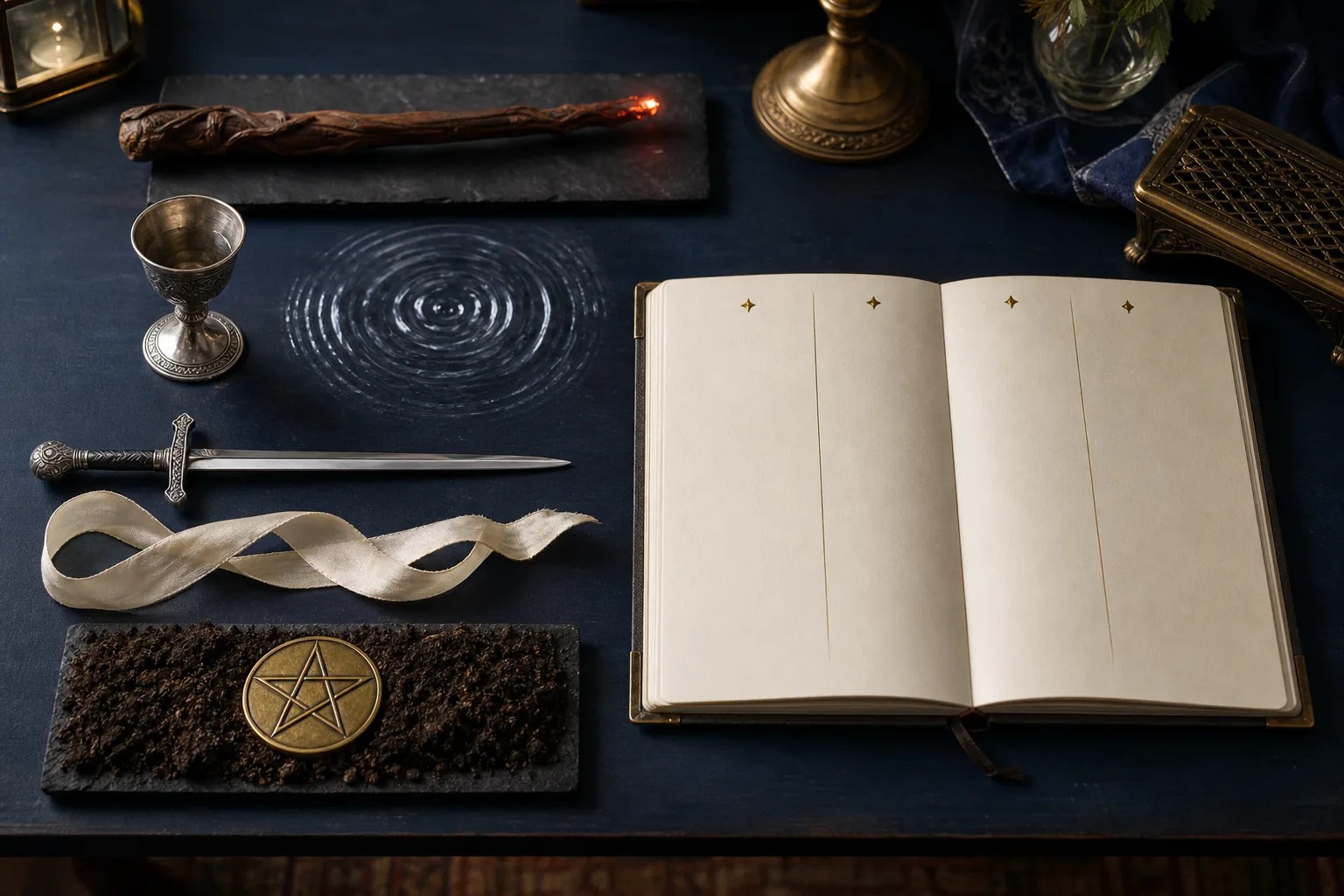
This Kismerene Mystic method helps beginners move beyond isolated keywords.
Step One: Identify the suit’s domain
Name where the card directs attention: Wands and drive, Cups and feeling, Swords and thought, or Pentacles and practical resources.
Step Two: Turn the suit into a verb
Move from an abstract noun to a provisional action: Wands “initiate or invest,” Cups “feel or connect,” Swords “clarify or decide,” and Pentacles “build or maintain.” Adjust the verb using the image and spread position.
Step Three: Look for real evidence
Separate association from confirmed fact. What did the person explicitly say? What does the contract state? What is happening in the body? Which work is actually complete? If evidence is missing, preserve it as a question rather than promoting it to a conclusion.
Step Four: Write one testable action
The action might be one direct conversation, a week of emotion notes, a comparison of two written options, or a paid pilot instead of a full launch. Keep it limited, reversible, and attached to a review date.
| Card | Suit verb | Real evidence | Testable action |
|---|---|---|---|
| Two of Wands | Plan a next step | There is an idea, but no demand evidence | Interview three potential users before investing |
| Two of Cups | Build reciprocity | Both people will talk, but boundaries are unclear | Hold one conversation about expectations and limits |
| Eight of Swords | Clarify constraints | Only one option is known to be closed | List three remaining paths and verify their conditions |
| Eight of Pentacles | Practice and refine | Four practice sessions are complete | Track quality and time cost for one more week |
The card organizes observation; it does not authorize an outcome.
Common Myths About the Four Tarot Suits
| Common myth | More reliable reading |
|---|---|
| Wands always mean passion and success | They show how drive is used, including impatience, competition, or burnout |
| Cups prove true love | They address emotion and relationship experience, not reciprocity or another person’s thoughts |
| Swords are all bad cards | They can also support clarity, communication, judgment, and boundaries |
| Pentacles only mean money | They also involve the body, work, time, skill, and practical maintenance |
| Major Arcana make Minor Arcana unimportant | The layers answer different questions; wider themes and daily details work together |
| Memorizing suit keywords completes a reading | Question, position, number or rank, image, and real context still matter |
Suits are not shortcuts for labeling a person or predicting an event. Their value is in helping you ask a more precise question.
Frequently Asked Questions
Which tarot suit is strongest or best?
None is universally strongest. Each suit addresses a different domain; relevance depends on the question, spread position, individual card, and real context.
Do Pentacles always mean money?
No. Pentacles also commonly address the body, work, skill, time, household matters, and maintainable resources.
Do Cups always mean love?
No. Cups can describe many emotions and relationships, including friendship, family, grief, imagination, and the reader’s own feelings. They cannot prove romance.
Why are Wands Fire and Cups Water?
Many modern Western esoteric and tarot systems use these symbolic correspondences to distinguish action, emotion, thought, and material process. Other decks may use different arrangements.
What does it mean when a suit is missing from a spread?
Do not treat absence as a personality or destiny diagnosis. A limited draw may simply not emphasize that domain, and the question and positions also shape the reading.
Do beginners need to memorize all 56 Minor Arcana cards?
Not at once. Learn the suit domains first, then observe how number, court rank, image, question, and position combine. This is more useful than memorizing isolated keywords.
About the Author
Hi, I’m Peter. I also began with “Wands mean career, Cups mean love, Swords mean bad news, and Pentacles mean money.” Tarot became more useful when I started treating each suit as a direction for inquiry rather than a ready-made answer. Kismerene Mystic is my independent project, and I want each reading to return to evidence, boundaries, and one next step that can be tested.
Disclaimer
This article is for tarot culture, symbolic learning, and reflection. It is not medical, psychological, legal, financial, relationship, or safety advice. Tarot cannot verify another person’s thoughts, consent, or future behavior, and it cannot replace qualified support. Read the full disclaimer and interpretation method.
Related Reading
- Major vs. Minor Arcana
- How to Read Tarot Court Cards
- How to Read a Three-Card Tarot Spread
- How to Ask Better Tarot Questions
- Browse the Tarot Card Library
Sources
- A. E. Waite, The Pictorial Key to the Tarot—used to verify the four-suit structure of the Minor Arcana in the Rider–Waite tradition; the practical reading method is editorial synthesis.
- Google Search Central: Creating helpful, reliable, people-first content—used for editorial checks on practical value, authorship, and user focus; it does not validate tarot.