
By Peter|Published August 12, 2026|Last updated August 12, 2026
A three-card spread offers more story than a single card without the complexity of a large layout. Its difficulty is equally simple: three dictionary meanings can produce three sentences without producing one useful reading.
A grounded reading defines what each position asks, observes how the cards repeat, challenge, or move one another, and turns the whole pattern into a real-world observation or action.
Short answer
How do you read a three-card tarot spread? Define the function of all three positions before drawing. Observe each image, then compare figure direction, repeated elements, numbers, suits, and the balance of Major and Minor Arcana. Do not read the cards as three unrelated keywords. Find their connections and translate the combined story into one testable observation or action.
Reading boundary
This article uses Rider–Waite–Smith imagery and a modern contextual approach. Decks and readers vary. Tarot cannot verify private thoughts, guarantee the future, diagnose health, or replace legal, financial, mental-health, or safety judgment.
Contents
- Position options
- How to ask the question
- Card first or whole spread first
- Five types of connection
- The Card–Link–Action Method
- Worked example
- Reversals
- Common mistakes
- FAQ
What Can the Three Positions Represent?
Past–present–future is one option, not a requirement. Positions should work together to answer one question.
| Three-card structure | Useful question |
|---|---|
| Situation–obstacle–action | How can I move a real problem forward? |
| Thought–feeling–behavior | How can I understand an internal conflict? |
| Known–unknown–verify | Which assumption needs evidence? |
| Option A–Option B–shared condition | What does each choice require? |
| Begin–sustain–adapt | How can a plan move from launch to continuity? |
A beautifully designed spread still cannot verify whether another person secretly loves you. Ask instead what communication, boundaries, and behavior you need to observe.
How Should You Ask the Question?
A helpful question has a clear context, limited scope, real facts, and an actionable direction.
Instead of “Will I succeed?” ask:
“As I develop this project over the next four weeks, what situation, obstacle, and next action should I examine?”
The principle matches a one-card reading, while three cards allow comparison. See how to ask a helpful tarot question.
Should You Read Each Card First or the Whole Spread?
You need both, in this order:
- Reread the question and positions.
- Describe one visible feature in each card.
- Examine what changes when the images sit together.
- Consult traditional meanings to correct—not replace—observation.
Starting with memorized keywords can hide figures turning away from each other, darkening color, repeated suits, or a Major Arcana card framing the entire scene.
Five Connections to Look for Between Cards
1. Figure Direction
Figures may face the center, turn away, or look in one direction. Treat direction as a visual clue, not proof that a person will leave.
2. Repeated Elements and Suits
Several Cups may foreground feeling and relationship; several Swords may emphasize thought, language, or conflict. The suit–element correspondences are common Western esoteric conventions, not universal deck rules.
3. Number Movement
Sequential numbers can suggest development, while decreasing numbers may invite review. Do not force a pattern while ignoring the image.
4. Major and Minor Arcana Balance
Major Arcana can spotlight a broad theme; Minor Arcana show how it operates in everyday detail. Major does not mean catastrophic, and Minor does not mean unimportant. Read the difference between Major and Minor Arcana.
5. Repetition and Tension
One card can support another or introduce a condition. “Move quickly” beside “wait for information” may ask when action is appropriate and what fact is missing.
The Card–Link–Action Method
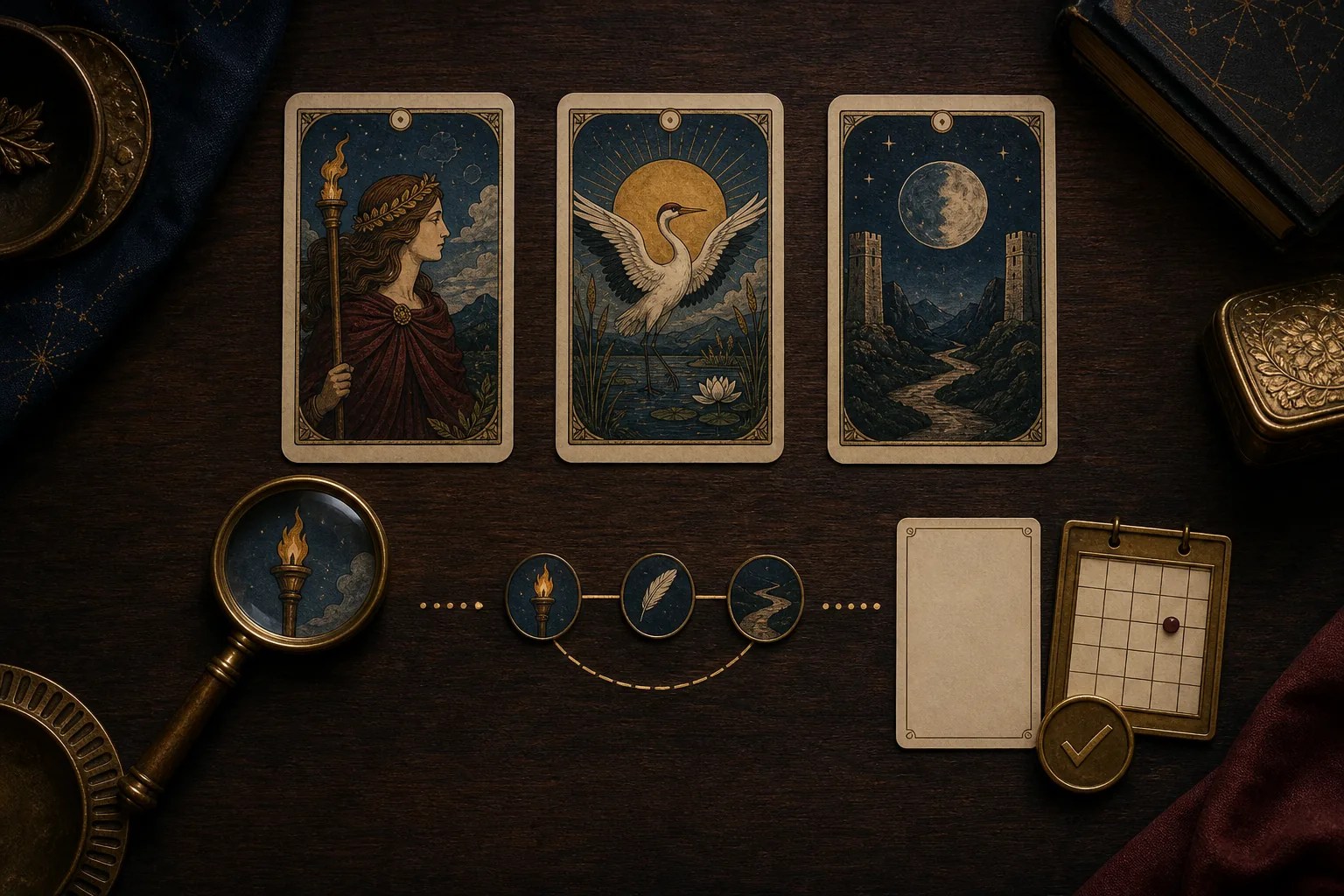
This is a compact framework developed by Kismerene Mystic.
Step 1: Card
For each card, write the first visible detail, its role in the assigned position, and its most direct connection to the question. Avoid a guaranteed prediction.
Step 2: Link
Write at least two relationships between cards: figure direction, repeated elements, a change in tone, or movement from stillness to action.
Step 3: Action
Compress the combined story into one fact to verify, one controllable action, and one review time.
| Card | Link | Action |
|---|---|---|
| Describe the three images | Find at least two relationships | Write a fact, action, and review date |
| Do not announce the outcome first | Allow support and tension | Keep it reversible and testable |
The method prevents a three-card spread from becoming three separate guesses.
A Worked Three-Card Example
Question: “As I test freelance work over the next four weeks, what situation, obstacle, and action should I examine?”
Suppose the cards are:
- Situation—The Chariot: direction and agency, alongside opposing forces that require coordination;
- Obstacle—Two of Swords: incomplete information or avoided choice;
- Action—Eight of Pentacles: repeated practice and concrete work.
Read separately, the cards become “advance, hesitate, work.” Connected, they suggest that motivation is not the main problem: one missing fact must be addressed, then a repeatable work process can test the direction.
A grounded action might be to keep the current job, complete one paid pilot, list facts about price, time, and client sources, and review real feedback after seven days. The cards did not authorize resignation; they structured a test.
What If One Card Is Reversed?
A reversal does not automatically mean bad or the opposite of upright. Test whether the same theme is blocked, internalized, excessive, or still developing.
Read its assigned position first, then ask whether it interrupts the other two cards. A reversal in the action position might mean reduce the step, adjust timing, or address internal resistance—not inevitable failure.
See four practical ways to read tarot reversals.
Common Three-Card Reading Mistakes
| Error | Fix |
|---|---|
| Treating the cards as isolated keywords | Write at least two card-to-card connections |
| Changing positions after drawing | Record the question and positions first |
| Pulling clarifiers until the answer feels pleasant | Complete the original spread and set a review time |
| Treating the future position as guaranteed | Read it as a possible extension of current conditions |
| Using cards to expose another person's secrets | Return to observable behavior, communication, and consent |
| Escalating every Major Arcana card | Treat it as a thematic spotlight, not an event guarantee |
Frequently Asked Questions
Must the cards mean past, present, and future?
No. Any three clearly defined functions that work together can form a useful spread.
Should I read from left to right?
Usually follow the position order established before drawing, while also observing figure direction and composition. Do not rearrange cards after the draw to manufacture a preferred answer.
Can a three-card spread answer yes or no?
Readers can design such methods, but complex questions usually benefit more from conditions, obstacles, and actions than a guaranteed yes or no.
What if all three cards look negative?
Describe the specific tension, then separate facts, risks, and controllable actions. Difficult cards do not guarantee disaster. For real danger, use a safety plan and qualified support.
Must beginners memorize all 78 cards?
No. Begin with imagery, positions, and relationships, then develop traditional knowledge gradually. Browse the 78-card tarot library.
About the Author
Hi, I'm Peter. What interests me about three cards is not getting three answers; it is watching three pictures begin to speak to one another. I independently maintain Kismerene Mystic, including topic selection, source checks, editing, and publishing review. Tarot here helps organize a question; it does not expose private thoughts or decide the future.
Disclaimer
This article is for cultural, symbolic, and reflective purposes only. It is not medical, mental-health, legal, financial, or safety advice. Tarot cannot verify private thoughts, guarantee outcomes, or replace professional judgment. Read the full disclaimer and reading method.
Related Reading and Tools
- Three-Card Tarot Reading
- How to Ask a Helpful Tarot Question
- Major vs. Minor Arcana
- How to Read Tarot Reversals
Sources
- A. E. Waite, The Pictorial Key to the Tarot—historical Rider–Waite–Smith meanings; Card–Link–Action is this site's editorial method, not a spread prescribed by Waite.
- Google Search Central: Creating Helpful, Reliable, People-First Content—used for editorial boundaries and reader usefulness, not as evidence that tarot predicts outcomes.