
By Peter | Published August 5, 2026 | Last updated August 5, 2026
When a card appears upside down, many beginners immediately translate it as “bad news” or search for the opposite of the upright keyword. The Sun reversed becomes unhappiness, The Lovers reversed becomes a breakup, and Ten of Pentacles reversed becomes financial ruin. This is fast, but it removes the question, spread position, and image from the reading. Because spread position changes how a reversal is read, see six practical three-card tarot spreads for layouts that define each position before drawing.
Short answer
Do reversed tarot cards always mean something bad? No. A reversal usually shows the same card's theme working in a different state: blocked, internalized, excessive, or not yet mature. It may even weaken a difficult pattern rather than make it worse. A reversed card is not a fixed opposite or an event guarantee; it must be read with the question, spread position, and surrounding cards.
Interpretation boundary
This article uses Rider–Waite–Smith imagery and a modern contextual reading method. Other decks and readers may use different reversal systems or no reversals at all. Tarot cannot verify another person's private thoughts, guarantee an outcome, or replace medical, mental-health, legal, financial, or safety judgment. See our reading method.
Table of Contents
- What is a tarot reversal?
- Why reversed does not simply mean opposite
- Four ways to read a reversal
- How to choose the relevant method
- A complete example
- Can you read without reversals?
- A five-step reversal exercise
- Common mistakes
- Frequently asked questions
What Is a Tarot Reversal?
A card is usually called reversed when it appears rotated 180 degrees relative to the reader. Some historical and modern tarot books provide upright and reversed meanings for each card. Other readers treat a reversal as a change in the direction, intensity, or development of the same underlying theme.
Reversals are not mandatory. Some readers allow cards to turn naturally during shuffling; some keep every card upright; others turn a reversed card upright but retain it as a prompt for closer examination. Any of these approaches can work when the rule is chosen before the reading and used consistently.
If the 78-card structure is unfamiliar, begin with Major vs. Minor Arcana. A reversal does not change a card's arcana, suit, or numerical stage. It changes the angle from which its expression is examined.
Why Does Reversed Not Simply Mean Opposite?
Mechanical opposites create three problems.
First, many upright cards already hold both an opportunity and a risk. The Chariot's direction can harden into excessive control; The Hermit's reflection can become isolation. Rotation does not require an unrelated theme.
Second, the reversal of a difficult card may show pressure loosening. A conflict may be weakening, an old pattern may be recognized, or the most intense stage may be passing. Evidence is still needed; the card cannot guarantee that the difficulty is over.
Third, position changes the task. A reversed card in “what to develop,” “the obstacle,” and “the next action” cannot responsibly become the same sentence.
A reversal therefore adds a question mark to the original theme: Where is this force blocked, turned inward, overused, or not yet ready?
Four Practical Ways to Read a Reversed Tarot Card
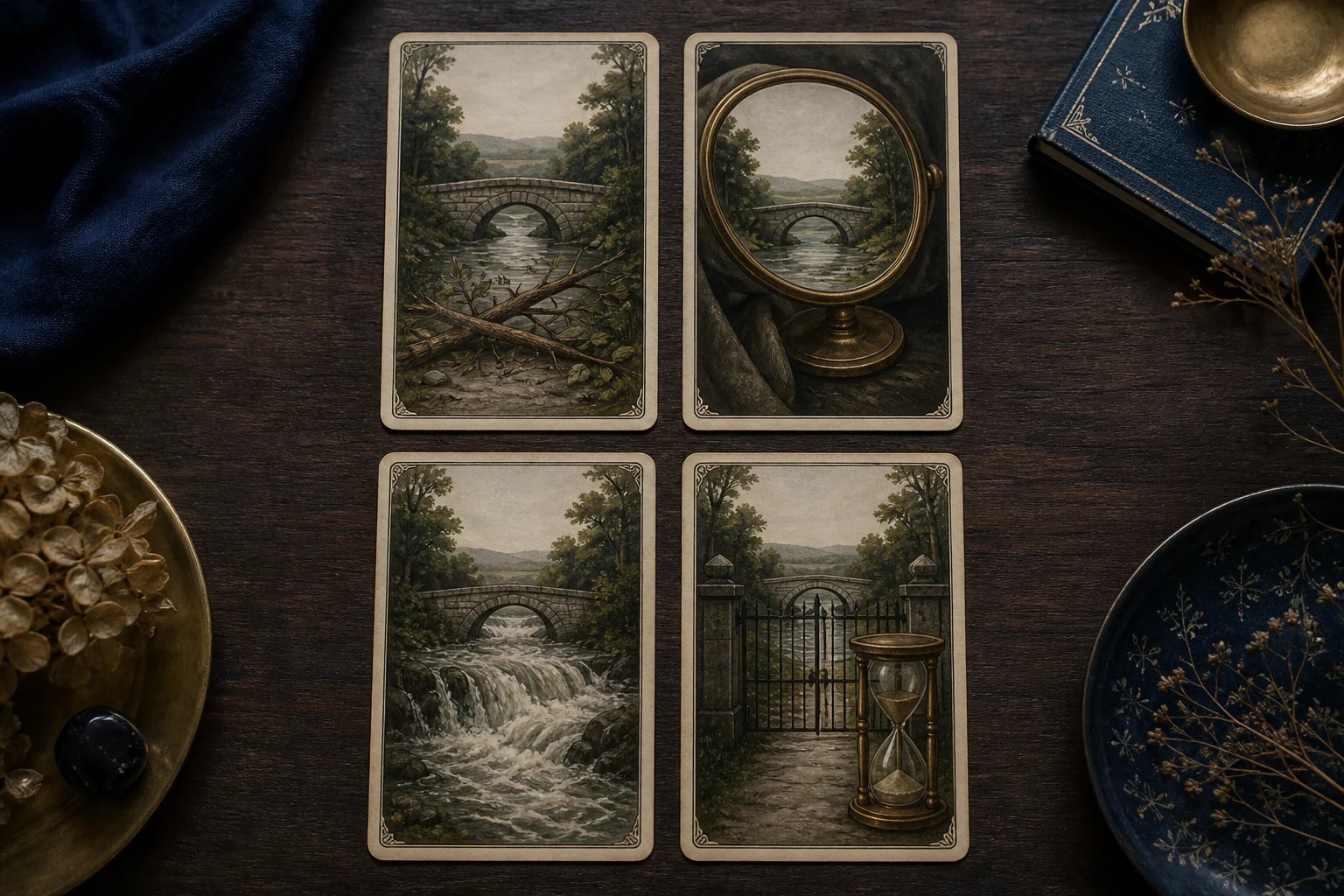
| Reversal state | What it describes | Question to ask |
|---|---|---|
| Blocked | The theme wants expression but meets fear, missing information, limited resources, or outside conditions | What specific obstacle prevents this quality from working? |
| Internalized | The theme is mainly occurring inwardly and has not been communicated or made visible | What am I processing privately, and does it need expression? |
| Excessive | A useful quality is applied too strongly and begins to create the opposite effect | Which strength has exceeded what the situation needs? |
| Delayed or immature | The theme is forming, but timing, skill, or supporting conditions are incomplete | What preparation is missing, and how will readiness be recognized? |
These are candidate hypotheses, not four answers to recite at once. The image, question, and real situation should narrow the field.
1. Blocked
Ace of Wands reversed in a next-action position may not mean “you have no creativity.” The beginning may lack time, permission, or resources. The useful task is to identify the actual obstacle rather than blaming deficient energy.
2. Internalized
High Priestess reversed does not have to mean “ignoring intuition.” It may show a judgment remaining internal because language has not formed around it. Is silence protecting reflection, or preventing necessary information from being discussed?
3. Excessive
Strength reversed may examine whether self-control has become too tight. Patience and gentleness can help, but continuously suppressing anger or need may turn gentleness into self-erasure.
4. Delayed or Immature
Page of Pentacles reversed may show that a plan has not entered steady learning and execution. This need not mean permanent failure. The budget, schedule, or foundational skill may simply be incomplete.
How Do You Choose the Relevant Reversal Method?
Instead of beginning with “What does this card usually mean?”, check the following in order:
- What is the question? Love, work, and self-observation require different evidence.
- What is the spread position? An obstacle position already asks about resistance; a resource position may reveal an unused ability.
- What happens in the image? Notice gaze, movement, distance, weather, and whether an object already suggests restraint or excess.
- What do surrounding cards emphasize? Several cards may converge on communication, resources, pace, or boundaries.
- Which interpretation can be checked? Prefer the reading that creates a next observation or reversible action, not the most dramatic story.
Two states may overlap—for example, a quality may be externally blocked because it has remained internal. But keeping every possibility produces no judgment. Write one main hypothesis and one alternative, then state what evidence would distinguish them.
A Complete Example: Queen of Cups Reversed
The question is, “What pattern needs my attention in this relationship?” The position is “current pattern,” and Queen of Cups appears reversed.
A mechanical opposite might label the card emotional, dependent, or unreliable. The four methods create a more useful investigation:
- Blocked: Feelings are present, but there is no safe way to express them.
- Internalized: Care flows toward others while personal emotion is handled alone.
- Excessive: Empathy expands into carrying another person's consequences, weakening boundaries.
- Delayed: Stable self-soothing and communication skills are still developing.
If ordinary life already shows overgiving and difficulty saying no, the main hypothesis may be “care is crossing my own boundary.” The next step is not to predict a breakup. It is to record three moments during one week when you want to agree but do not genuinely consent, then practice one clear refusal.
The card supplies language; observable behavior determines whether the reading is useful.
Can You Read Tarot Without Reversals?
Yes. Seventy-eight images, spread positions, suits, numbers, and elemental relationships already provide extensive variation. Using upright cards only is not less serious; the reader still needs to see constructive expression, shadow, absence, and excess within each card.
Beginners can keep all cards upright and ask, “How would this quality look if it were insufficient, excessive, or blocked?” Once the upright structure is familiar, decide whether physical reversals add clarity.
The question you bring matters as much as the orientation rule; see how to ask a helpful question for a one-card tarot reading.
If you use reversals, set the rule before drawing: how cards become reversed, whose viewpoint determines orientation, whether a card may be turned upright, and what kind of change reversal represents. Changing the rule mid-reading to make a result feel better undermines consistency.
A Five-Step Tarot Reversal Exercise
Choose a familiar card from the complete 78-card library or begin a three-card reading:
- Observe the upright image and record three visible details.
- State its central theme in the current question in one sentence.
- Rotate it 180 degrees and choose one candidate: blocked, internalized, excessive, or delayed.
- Write one piece of real evidence supporting that reading and one that challenges it.
- Rewrite the conclusion as an observable question or reversible action.
The goal is not the “most accurate” prediction. It is an interpretation that can be explained, checked, and revised when new information appears.
Common Tarot Reversal Mistakes
| Mistake | Better method |
|---|---|
| Treating every reversal as bad | Check blocked, internalized, excessive, or delayed; a difficult pattern may also be weakening. |
| Looking up the opposite of the upright keyword | Preserve the original theme and examine direction, intensity, and development. |
| Turning the card upright because the result feels unpleasant | Choose the rule before the reading and apply it consistently. |
| Using a reversal to prove deception, betrayal, or malicious intent | Convert it into a hypothesis that requires communication and factual evidence. |
| Declaring failure or breakup from one reversed card | Use the question, position, surrounding cards, and real conditions; the card does not guarantee an outcome. |
Frequently Asked Questions
Are reversed tarot cards always more negative than upright cards?
No. A reversal describes a state of expression, not a fixed moral value. It may be blocked, internalized, excessive, delayed, or show a difficult pattern beginning to weaken.
Do I need to memorize separate keywords for all 78 reversals?
No. Understand the upright image and central theme first, then apply a consistent reversal framework. This is usually more stable than memorizing 78 sets of opposites.
What if a card accidentally turns upside down while shuffling?
If the reading was set to upright-only, turn it upright. If reversals are in use, retain it according to the chosen rule. Consistency matters more than mystifying an accidental movement.
Can a reversed card prove that someone is lying?
No. It may raise a question about communication, concealment, or missing information, but dialogue, records, and behavior are needed to assess the claim.
Should beginners use reversals?
They do not have to. Learn the upright images, suits, numbers, and spread positions first, then decide whether reversals genuinely improve clarity.
Final Thought
A reversal does not make a card bad. It changes the direction, intensity, or maturity of the same underlying theme.
When you stop searching for automatic opposites, better questions become possible: Where is it blocked? Is it happening inwardly? Has it become excessive? What condition is not ready? The answer still needs to be tested in ordinary life.
About the Author
Hi, I’m Peter. I used to treat reversed cards as bad news until I learned they’re more like another angle. Kismerene Mystic is my one-person project, and I write about tarot, astrology, and the Five Elements—but I’d never tell you a symbol “guarantees” what will happen. That’s not a sentence I believe. I’d rather help you ask the question that’s actually stuck: what are you really trying to sort out right now? Symbols are here to help us talk clearly—the decisions stay with you.
Disclaimer: Tarot is a symbolic and narrative practice. It cannot verify another person's private thoughts or replace medical, mental-health, legal, financial, or safety judgment. See our reading method and full disclaimer.
Related Reading and Source
- Major vs. Minor Arcana
- Browse all 78 tarot cards
- Three-card tarot reading
- A. E. Waite, The Pictorial Key to the Tarot (historical meanings, including reversed entries for many cards)