MINOR ARCANA · SWORDS
Ten of Swords Tarot Card Meaning
Upright, reversed, love, career, and practical readings
A painful pattern has reached its limit; the ending is stark, but dawn makes continuation possible. In a reading, it usually concerns thought, language, conflict, decision, and the consequences of belief.
AT A GLANCE
Ten of Swords: core meaning
A painful pattern has reached its limit; the ending is stark, but dawn makes continuation possible.
Collapse is dramatized or resisted, betrayal is replayed, or recovery begins before the lesson is integrated. Upright and reversed do not simply mean good and bad; the better fit depends on what is actually happening.
THE CARD'S STORY · MINOR ARCANA · SWORDS
The moment held inside Ten of Swords
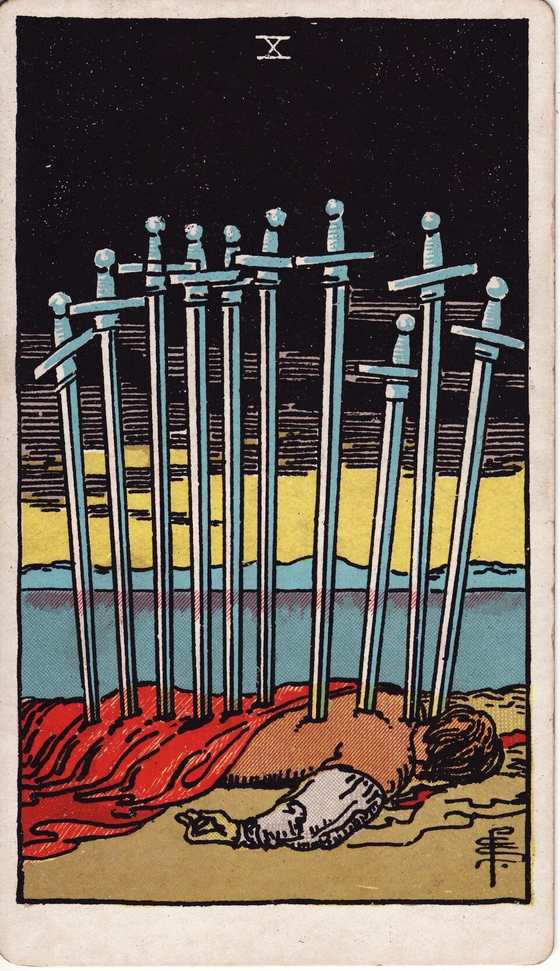
A figure lies beneath ten swords as dark clouds lift over a bright horizon. The scene holds a choice or change before it has fully resolved.
The figures, gestures, and objects give “ending, exhaustion” a visible, practical context.
Collapse is dramatized or resisted, betrayal is replayed, or recovery begins before the lesson is integrated. If the card is reversed, appears as an obstacle, or sits beside conflicting cards, begin by checking for these specific signs.
A painful pattern has reached its limit; the ending is stark, but dawn makes continuation possible.
THE IMAGE
What is happening in Ten of Swords?
Look at the figures, action, and setting before reading the keywords. Concrete details in the image are often more useful than a memorized definition.
A figure lies beneath ten swords as dark clouds lift over a bright horizon.
completion, accumulation, and the point where a cycle must change form
This card mainly concerns thought, language, conflict, decision, and the consequences of belief. Connect it to a specific person, choice, or situation in the question.
Notice where the figures look, what they approach or avoid, and the distance between foreground and horizon. These details help show whether events are beginning, moving, or due for adjustment.
UPRIGHT & REVERSED
One energy, expressed in two different ways
Upright usually emphasizes the more direct expression of ending, exhaustion, finality. Reversed may indicate blockage, excess, internalization, or poor timing.
UPRIGHT
Ten of Swords upright
A painful pattern has reached its limit; the ending is stark, but dawn makes continuation possible.
- Situation: The issue involves ending, exhaustion, finality. Identify the person, choice, or stage of events that matches those words.
- Main meaning: A painful pattern has reached its limit; the ending is stark, but dawn makes continuation possible.
- Possible expression: It may appear as a shift in relationship, work, money, study rhythm, health of a routine, or self-positioning.
- Watch for: Even when the direction is sound, check timing, resources, boundaries, and the real willingness of other people.
- Advice: Choose one small action that can be completed or confirmed in real life.
- Next step: Separate what is known, unknown, and directly verifiable before deciding the scale of action.
REVERSED
Ten of Swords reversed
Collapse is dramatized or resisted, betrayal is replayed, or recovery begins before the lesson is integrated.
- Situation: Progress may be blocked, excessive, or pushed at the wrong time.
- Main caution: Collapse is dramatized or resisted, betrayal is replayed, or recovery begins before the lesson is integrated.
- Inner state: You may already sense that something is off without having named the problem clearly.
- Relationship pattern: Communication, responsibility, or boundaries remain undefined, allowing the same issue to repeat.
- What is missing: Check the information gap, practical capacity, cost of commitment, and exit conditions.
- Advice: Do not treat reversal as a bad outcome. Decide whether it asks you to slow, correct, contain, or stop.
LOVE & RELATIONSHIPS
Ten of Swords in love and relationships
In relationship questions, Ten of Swords often draws attention to thought, language, conflict, decision, and the consequences of belief.
Upright: A painful pattern has reached its limit; the ending is stark, but dawn makes continuation possible. Let real interaction develop before forcing a conclusion.
REVERSED: Reversed: Collapse is dramatized or resisted, betrayal is replayed, or recovery begins before the lesson is integrated. Confirm what the other person can actually offer instead of reading atmosphere alone.
They may be drawn to ending, exhaustion, finality, but one card does not establish intention or commitment.
REVERSED: Reversed, feeling and action may not align. A direct question is more useful than prolonged guessing.
Translate this meaning—a painful pattern has reached its limit; the ending is stark, but dawn makes continuation possible—into one adjustment both people can participate in.
REVERSED: Do not let this shadow—collapse is dramatized or resisted, betrayal is replayed, or recovery begins before the lesson is integrated—remain the background of a repeating argument; revisit responsibility, rhythm, or boundaries.
The card can support understanding the past differently, but reconciliation depends on changed behavior.
REVERSED: If the old issue remains intact, reversal warns against mistaking familiarity for repair.
CAREER, STUDY & MONEY
Ten of Swords in career, study, and money
In career, study, and money, this card grounds ending, exhaustion, finality in resources, responsibility, and executable steps.
Upright: A painful pattern has reached its limit; the ending is stark, but dawn makes continuation possible. Verify role, compensation, and development before committing.
REVERSED: Reversed: Collapse is dramatized or resisted, betrayal is replayed, or recovery begins before the lesson is integrated. Be cautious with vague promises, impulsive exits, or incomplete information.
Upright: translate the card into an owner, deadline, and one deliverable stage.
REVERSED: Reversed: address shifting goals, communication gaps, or a mismatch between work and resources.
Upright: build a repeatable practice around the card's central theme so insight becomes skill.
REVERSED: Reversed: reduce constant method-switching and identify the real barrier to follow-through.
Upright: allocate resources within a tolerable range and keep a record for review.
REVERSED: Reversed: avoid deciding from hope or fear alone; investments, loans, and contracts require facts and professional advice.
READING POSITIONS
Ten of Swords in common spread positions
A card answers the position it occupies. Advice, obstacle, and outcome are not interchangeable.
This person may express ending, exhaustion, finality. Maturely: A painful pattern has reached its limit; the ending is stark, but dawn makes continuation possible. In shadow: Collapse is dramatized or resisted, betrayal is replayed, or recovery begins before the lesson is integrated.
Their attention may be on this card's theme, but thought does not automatically equal action or commitment.
Translate this meaning—a painful pattern has reached its limit; the ending is stark, but dawn makes continuation possible—into one bounded, concrete action whose result can be observed.
You may be experiencing this shadow: collapse is dramatized or resisted, betrayal is replayed, or recovery begins before the lesson is integrated. Decide whether the problem is missing information, excess energy, or unclear boundaries.
The situation may move toward ending, exhaustion, finality, but stability still depends on later choices and surrounding cards.
Notice one concrete moment related to ending, exhaustion, finality, and record it before over-interpreting it.
This card is better at answering “under what conditions?” than providing an absolute yes or no without context.
The image can describe beginning, movement, pause, or completion; it cannot reliably name an exact date.
Let the central energy support a real decision rather than replace real-world judgment.
READING METHOD
Ask these three questions when Ten of Swords appears
- 01What does this card point to in my actual question?
Ground the keyword in one person, decision, resource, or time frame.
- 02Which side—upright or reversed—fits the present situation?
Compare both readings with observable behavior and evidence.
- 03What is the smallest step I can test today?
Choose an action that is observable, proportionate, and reversible when necessary.
This is not an absolute yes or no outside context. Questions involving health, safety, law, investment, or major commitments require reliable facts and qualified advice.
COMMON MISREADS
COMMON MISREADS
The card describes a theme and tension, not a fixed event list. Position, question, surrounding cards, and real action still change the reading.
Reversal may show blockage, excess, internalization, or timing—not a mechanical flip of every keyword.
A single card can offer perspective; it cannot replace communication, evidence, or professional judgment.