
By Peter|Published August 25, 2026
When you stand within a space, direction can feel like more than an arrow on a map. East carries dawn and emergence. South brings visibility and warmth. West invites completion. North protects what is still gathering strength, while the center gives every movement somewhere to land.
Wuxing weaves direction, season, yin–yang movement, and the rhythm of life into a poetic energy map. Learning East–Wood, South–Fire, Center–Earth, West–Metal, and North–Water is not about surrendering to rules. It is a way to ask what your life needs now: a beginning, visibility, support, release, or quiet restoration.
Short answer
Why does Wuxing correspond to directions? East carries spring’s awakening and therefore Wood; south receives summer’s light and heat and therefore Fire; the center holds and transforms the four directions and therefore Earth; west echoes autumn’s refinement and release and therefore Metal; and north preserves life in winter’s depths and therefore Water. The Five Directions remind us that every kind of energy has a movement—and a season in which it is ready to awaken.
Contents
- The basic Five Directions map
- Why east corresponds to Wood
- Why south corresponds to Fire
- Why the center corresponds to Earth
- Why west corresponds to Metal
- Why north corresponds to Water
- How directions connect with seasons
- Using directions as energy anchors at home
- The Five-Direction Energy Anchoring Ritual
- Let your space hold your intention
- Frequently asked questions
What Is the Basic Wuxing Direction Map?
Traditional sources including the Bai Hu Tong discuss Water in the north, Wood in the east, Fire in the south, Metal in the west, and Earth at the center. Their explanations connect the waxing and waning of yin and yang with seasonal generation, growth, harvest, and storage.
| Direction | Phase | Seasonal link | Movement image |
|---|---|---|---|
| East | Wood | Spring | Emergence, extension, direction |
| South | Fire | Summer | Visibility, rising, heat, connection |
| Center | Earth | Transition or late summer | Support, transformation, coordination |
| West | Metal | Autumn | Contraction, formation, refinement, boundary |
| North | Water | Winter | Descent, storage, depth, waiting |
Think of the table as an inner compass. It does not dictate one road; it helps you feel the rhythm of the stage you are in. See Yin-yang and Wuxing for how these phases remain alive through movement.
Why Does East Correspond to Wood?
East is associated with sunrise, spring, and the first movement of yang. Wood describes emergence, extension, and direction. The Bai Hu Tong explains the east through the beginning of growth.
This does not mean that eastern space is physically made of Wood. It places direction in a temporal image of beginning. Wood in Wuxing also shows why growth needs direction and pruning.
Why Does South Correspond to Fire?
South is correlated with flourishing yang, summer, light, and heat. Fire describes visibility, expansion, connection, and consumption. The association concerns a stage of increased manifestation rather than a promise that southern orientation is automatically favorable.
Fire in Wuxing emphasizes that visibility and connection require fuel and can become overextension.
Why Does the Center Correspond to Earth?
Earth is often placed at the center because the center connects, supports, and transforms the other directions. Some traditions also associate Earth with late summer or the transitions between seasons.
Center Earth is not an instruction to pile yellow objects in the middle of a house. It is a coordinating position in a relationship model. See Earth in Wuxing.
Why Does West Correspond to Metal?
West is associated with sunset, autumn, contraction, and completion. Metal describes form, standards, boundaries, refinement, and release. Traditional explanations connect the west with rising yin and the restraint of flourishing life.
It does not mean the west is inherently a wealth sector. Metal in Wuxing is more about structure and selection than gold or income.
Why Does North Correspond to Water?
North is correlated with cold, winter, descent, and storage. Water describes moistening downward, preservation, depth, and latency. Reduced visible activity is not an absence of process; storage preserves conditions for another cycle.
Water in Wuxing distinguishes useful preservation from stagnation caused by fear.
How Do Directions Connect With Seasons?
Direction does not generate meaning alone. It belongs to a wider network of season, yin–yang movement, and daily cycles: east–spring–Wood begins; south–summer–Fire flourishes; west–autumn–Metal contracts; north–winter–Water stores; center–Earth coordinates transition.
This is why Wuxing and the seasons and this article support each other without becoming one universal table for every context.
How Can Wuxing Directions Become Energy Anchors at Home?
Let each direction become a gentle environmental cue. Keep an eastern corner for beginnings and planning. Use the south to display something ready to be seen. Let the center feel stable and open. Invite the west to hold what is being completed or released, and reserve the north for quiet thought and restoration.
The deepest form of alignment is not collecting more symbolic objects; it is shaping a space that supports the state you want to cultivate. A plant, color, crystal, or vessel can become a meaningful physical anchor, while light, airflow, movement, moisture, and safety give that intention a real container.
The Five-Direction Energy Anchoring Ritual
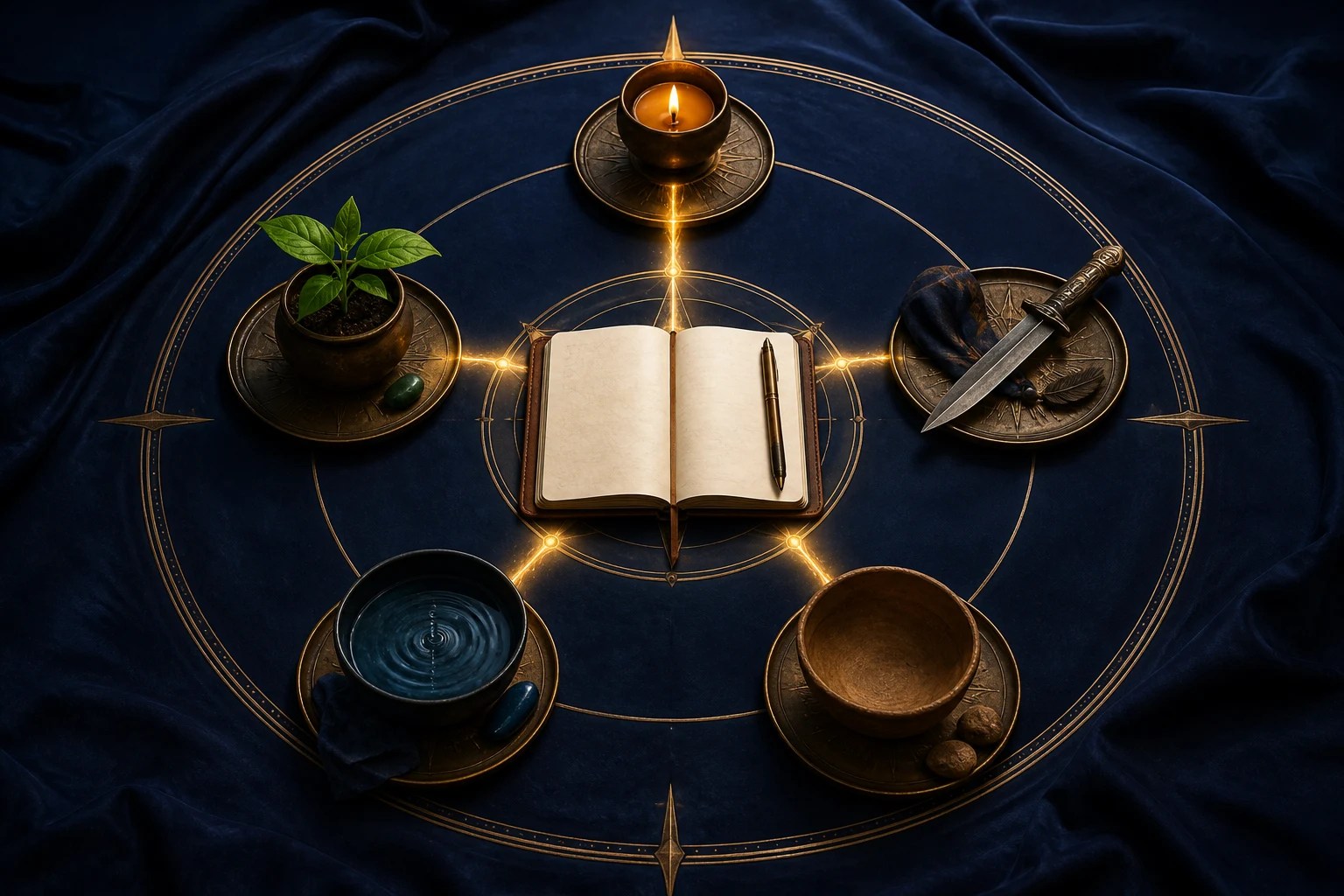
Choose the direction that calls to you most, then use four steps to bring its symbolic quality into one small action today.
1. Direction
Clarify whether you mean geographic direction, room orientation, a work zone, or a symbolic next stage.
2. Phase
Identify the associated process in the selected tradition: emergence, manifestation, transition, contraction, or storage.
3. Function
Translate the symbol into a real function. East–Wood might mean beginning and direction; West–Metal might mean editing and completion.
4. Conditions
Check light, space, safety, budget, time, and user needs before making one reversible adjustment.
Example: If your workspace sits in the east, borrow Wood’s image of emergence and place the first step of your current project there. Each time you see it, let the space call you back to one small beginning.
Let Your Space Hold Your Intention
| When symbolism becomes pressure | A more empowering use |
|---|---|
| Filling the east with plants and waiting for luck | Choose one object that reminds you to begin and keep growing |
| Adding an aquarium because north is Water | Express depth and flow in a form your space can safely sustain |
| Treating the west as a single wealth corner | Use Metal energy to complete, refine, and reclaim scattered attention |
| Piling yellow objects in the center | Keep the center steady and open so it can support the life around it |
| Moving because a direction feels “wrong” | Begin with a small, reversible shift that answers a real need |
Frequently Asked Questions
What are the standard Wuxing direction correspondences?
The common map is East–Wood, South–Fire, Center–Earth, West–Metal, and North–Water. Application still requires a stated tradition and scope.
Why is Earth at the center rather than an ordinary direction?
Earth often carries support, coordination, and transition, so it occupies the position connecting the four directions. Some systems also link it with late summer or seasonal transitions.
What is the spiritual meaning of Wuxing directions?
They can be experienced as a traditional compass for life energy: east awakens, south illuminates, center supports, west refines, and north restores. Their gift is helping you recognize the rhythm you need and carry that awareness into daily life.
Can room direction reveal a missing element?
Room direction is more useful for sensing spatial rhythm than for deciding what a person “lacks.” Your lived conditions, season, use of space, and the whole relationship offer richer clues.
Can I place crystals or plants according to Wuxing directions?
Yes. Crystals, plants, and color can become physical anchors for intention. Choose what genuinely feels steady and alive to you, while honoring light, moisture, maintenance, and safety so the symbol can remain supportive.
Should directions be measured from a map or the front door?
Different practices may use different references. If a method does not state its measurement basis, it should not claim precision. Real spatial planning requires a clear, consistent measurement.
About the Author
Hi, I’m Peter. I once memorized East–Wood, South–Fire, West–Metal, and North–Water as a static chart. Then I began listening to what each space seemed to ask for: courage to begin, permission to be seen, steadiness, release, or quiet renewal. I hope the Five Directions can become an inner compass for you, too.
A note on personal sovereignty: Wuxing directions can support cultural understanding, spatial awareness, and reflection. For architectural, health, legal, financial, or safety matters, pair symbolic practice with reliable information and qualified support. See our disclaimer.
Related Reading
- Why Wuxing corresponds to seasons
- Wood in Wuxing
- Fire in Wuxing
- Earth in Wuxing
- Metal in Wuxing
- Water in Wuxing
Sources and Editorial Notes
- Bai Hu Tong: Five Elements — primary traditional source for the five directions and their seasonal logic.
- Internet Encyclopedia of Philosophy: Wuxing — scholarly context for Wuxing as dynamic phases and a historical correlative system.
- Google Search Central: Creating helpful, reliable, people-first content — used for editorial review, not as a ranking guarantee.