
By:Peter|Published:2026-08-31
A birth chart can look like a night map threaded with golden lines. Those lines do not sentence you to a fate; they describe how different inner forces meet. Aspects show where energy flows, where it stretches, and where tension may become a doorway to integration.
Short answer
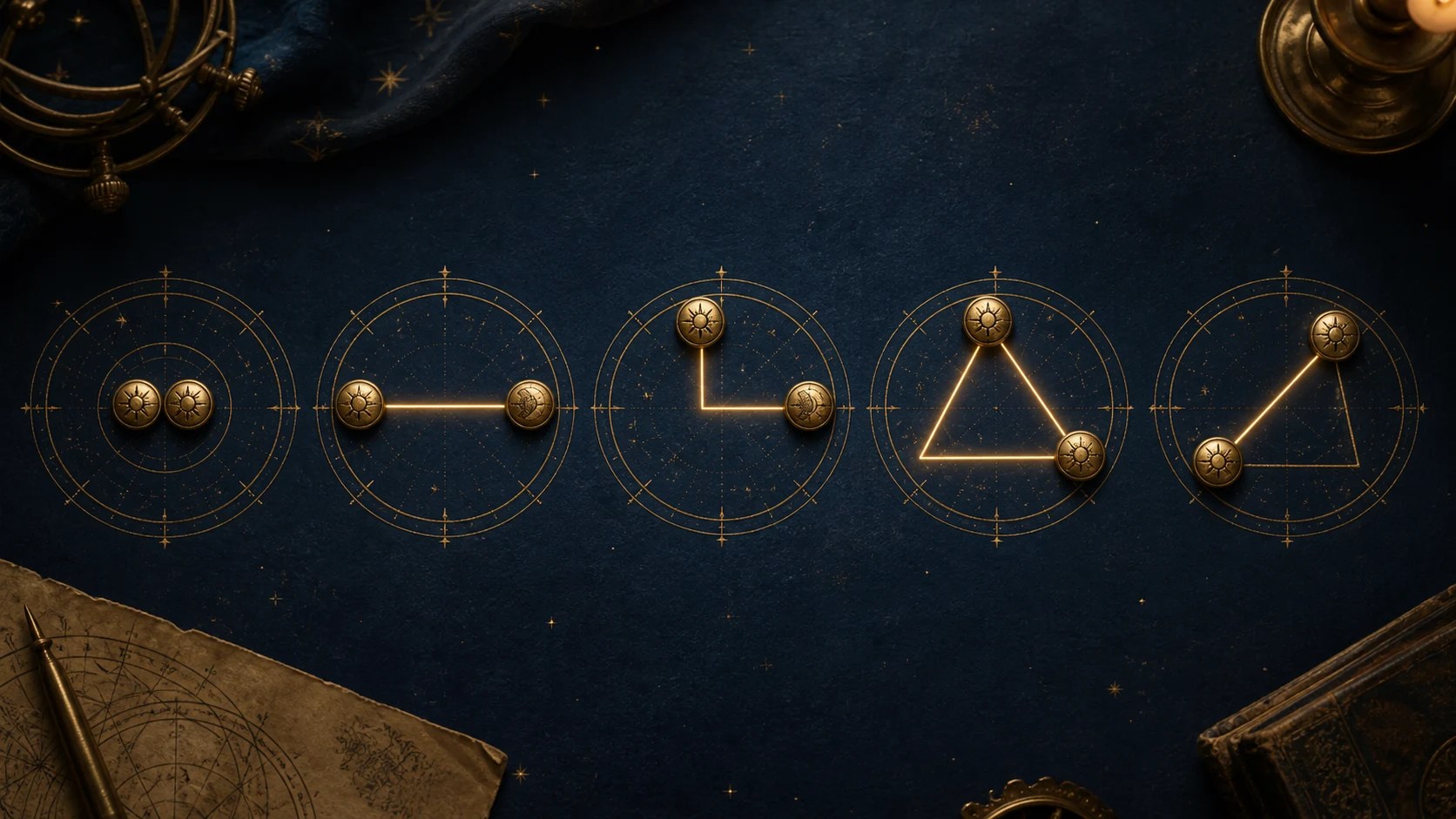
Aspects are angular relationships between planets. A conjunction concentrates two forces; an opposition creates a mirror; a square produces change-making friction; a trine suggests natural flow; and a sextile offers an opportunity that grows through participation.
Why This Theme May Be Calling You
A birth chart can look like a night map threaded with golden lines. Those lines do not sentence you to a fate; they describe how different inner forces meet. Aspects show where energy flows, where it stretches, and where tension may become a doorway to integration. When a subject keeps drawing your attention, it often means you are searching for language spacious enough to hold something that has been difficult to name. You may be standing before a choice, trying to understand a relationship, carrying a private hope, or sensing that an old rhythm no longer fits. What you need is not necessarily a sentence that decides the future for you. You may need a doorway that illuminates emotion and turns confusion into a pattern you can explore with patience.
In this article’s context, Aspects are angular relationships between planets. A conjunction concentrates two forces; an opposition creates a mirror; a square produces change-making friction; a trine suggests natural flow; and a sextile offers an opportunity that grows through participation. That is part of why the theme can feel comforting. It does not require you to become certain immediately. Instead, it gives names to experiences that may have been tangled together. Notice which word reaches you first: beginning, stability, boundary, relationship, intuition, release, or something else. The word that stays with you is not automatically an instruction. It may be the part of your life that most wants recognition, reassurance, or room to breathe.
Let the attraction remain gentle. You do not have to collect more signs to prove that the subject matters, and you do not have to dismiss your feelings simply because they cannot yet be explained. Treat this as a meeting between inherited symbolism and personal experience. Tradition offers a vocabulary; your circumstances supply the meaning that no general guide can know in advance. An interpretation becomes supportive when it helps you recognize your needs, care for your daily life, and keep the freedom to choose, revise, pause, or walk away. It should create room inside you rather than pressure you toward one dramatic conclusion.
The Core Meaning
Aspects are angular relationships between planets. A conjunction concentrates two forces; an opposition creates a mirror; a square produces change-making friction; a trine suggests natural flow; and a sextile offers an opportunity that grows through participation. This definition becomes useful only when it is placed back inside the wider system rather than reduced to the most attractive keyword. Symbolic traditions remain meaningful because one image, number, placement, material, or pattern can contain several expressions at once. It may describe a natural gift, an unfinished lesson, a source of hope, or an area where attention has become necessary. The same theme can feel easy in one life context and demanding in another.
A birth chart can look like a night map threaded with golden lines. Those lines do not sentence you to a fate; they describe how different inner forces meet. Aspects show where energy flows, where it stretches, and where tension may become a doorway to integration. A clear reading therefore benefits from three layers. The first is the traditional layer: what elements, numbers, positions, relationships, cycles, or historical associations belong to this theme? The second is the personal layer: what emotions and events in your life genuinely resemble those associations? The third is the response layer: after understanding the pattern, how might you care for yourself, communicate, or adjust your pace? These layers correct one another. They prevent a single appealing phrase from being used to explain an entire life.
Intensity is also different from goodness or danger. A theme that appears strongly does not automatically promise a blessing or predict a problem. It simply makes that area easier to notice. Depth comes from comparison, context, and time. The same symbol can emphasize different needs when the question, relationship, or stage of life changes. Instead of searching for one universal verdict, ask what the symbol is amplifying, what it is helping you notice, and which expression preserves both hope and honesty. That approach keeps the tradition alive while allowing your lived experience to remain the final context in which meaning is tested.
The Five Major Aspects Are More Than “Good” and “Bad”
| Aspect | Angle | A useful image | Main reading question |
|---|---|---|---|
| Conjunction | 0° | Two people occupying the same place | Do the planets cooperate, merge, or compete for expression? |
| Sextile | 60° | A door that still needs to be opened | What opportunity becomes real through participation? |
| Square | 90° | Two roads meeting at a hard corner | What skill must develop because neither need can be ignored? |
| Trine | 120° | Water moving naturally downhill | What ability flows easily, and is it being used consciously? |
| Opposition | 180° | Two people facing each other across a table | What polarity becomes visible through relationship or projection? |
The aspect name is only the beginning. A useful reading also asks which planets are involved, what signs and houses they occupy, and how far the actual distance is from the exact angle. That permitted distance is usually called an orb. Astrological schools disagree about exact orb limits, so an honest chart reading should state the convention being used rather than presenting one number as universal. As a practical rule inside astrology, a tighter aspect is usually treated as more immediately noticeable.
A concrete example: Sun square Moon
The Sun is traditionally associated with direction, will, and the self one is becoming. The Moon is associated with emotional safety, habit, and instinctive response. Sun square Moon does not mean a person is destined to live in permanent inner conflict. It may describe a recurring negotiation: the conscious self wants to pursue a visible opportunity while the body asks for rest; independence matters, yet reassurance is also needed. The developmental task is not to destroy one side. It is to build a life arrangement large enough for both. Someone considering an abrupt resignation, for example, might test freelance work for four weeks while keeping stable income. That choice gives the Sun movement and the Moon a safer container.
How to Place It in Your Present Life
To place this theme in your present life, resist the pressure to make one dramatic decision immediately. Sustainable change usually begins with an action small enough to observe and flexible enough to revise. Start by choosing to find one close aspect instead of reading the whole chart. The purpose is not to prove that one interpretation is correct. It is to move your attention away from endless guessing and back toward your own experience. Then name what each planet needs, allowing an abstract meaning to meet something concrete.
Next, notice the signs and houses involved. As you do this, separate three categories on paper: what you know as a fact, what you feel emotionally, and what you hope will happen. All three deserve respect, but they are not interchangeable. The distinction allows you to keep hope without asking hope to replace communication, time, consent, evidence, or changing circumstances. Finally, write one sentence about how the two energies can cooperate. Treat this as a gentle experiment rather than an irreversible promise. Give yourself permission to review what actually changed.
If another person is involved, leave room for what they have truly said, chosen, and communicated through their boundaries. If the question concerns money, health, or safety, let reliable information and qualified support stand beside intuition. Spiritual language is most empowering when it encourages you to care for reality rather than escape it. You can keep ritual, hope, beauty, and a sense of synchronicity while also creating room to rest, verify, and change direction. In this way the symbol becomes more than a temporary emotional high. It becomes a compassionate practice of attention, agency, and response.
A Gentle Four-Step Practice
- Find one close aspect instead of reading the whole chart
- Name what each planet needs
- Notice the signs and houses involved
- Write one sentence about how the two energies can cooperate
You do not have to change everything at once. Choose the step closest to your present life and let it become today’s tangible response.
How to Interpret Without Giving Away Your Power
Symbols can offer comfort, hope, and direction, and they can open a conversation with your intuition. Their most empowering use is to help you see your needs, boundaries, and next step—not to demand obedience to one fixed answer.
Frequently Asked Questions
Do more aspects mean a more difficult life?
Not necessarily. The pattern and the planets involved matter more than the count. The deeper reason this question matters is that most readers are not looking for a dictionary definition alone. They are trying to understand whether the symbol speaks to something they are living through right now. In the context of this article, Aspects are angular relationships between planets. A conjunction concentrates two forces; an opposition creates a mirror; a square produces change-making friction; a trine suggests natural flow; and a sextile offers an opportunity that grows through participation. This gives the question “Do more aspects mean a more difficult life?” two useful layers. The first is the traditional or popular meaning attached to the symbol. The second is the evidence of your own feelings, relationships, circumstances, and timing. Tradition can give language to an experience, but it does not need to make one final decision on your behalf.
A helpful interpretation should leave you feeling more present and more capable of choosing, not more frightened or dependent on repeated signs. Begin by asking what part of the answer feels emotionally true and what part still needs time or information. You can then find one close aspect instead of reading the whole chart, followed by name what each planet needs. If the meaning still feels unclear, notice the signs and houses involved, and use “Write one sentence about how the two energies can cooperate” as a small, adjustable experiment rather than an irreversible commitment. This approach does not remove the spiritual meaning. It gives intuition a practical container in which it can be felt, observed, and understood with care.
It can also help to compare the interpretation with what has actually been consistent in your life. Notice whether the same message still feels meaningful after a calm night, a direct conversation, or a little distance from the original emotion. A symbol that supports you does not need constant urgency. It can remain gentle while your understanding develops. If another person is involved, leave room for their words, choices, and boundaries instead of using the symbol to speak for them. If money, health, or safety is involved, let appropriate professional information stand beside your intuition.
The most supportive conclusion is therefore not a rigid prediction. It is an invitation to notice what the symbol awakens in you, name the support you genuinely need, and choose one next step that respects both your hope and your boundaries. If an interpretation helps you feel steadier, kinder toward yourself, and more able to respond to real life, it is likely serving you better than any answer that demands certainty. You are allowed to keep the meaning that brings clarity, question what creates fear, and revisit the answer as your circumstances change.
Is a square always bad?
No. Squares can feel demanding, but they often become sources of movement, skill, and resilience. The deeper reason this question matters is that most readers are not looking for a dictionary definition alone. They are trying to understand whether the symbol speaks to something they are living through right now. In the context of this article, Aspects are angular relationships between planets. A conjunction concentrates two forces; an opposition creates a mirror; a square produces change-making friction; a trine suggests natural flow; and a sextile offers an opportunity that grows through participation. This gives the question “Is a square always bad?” two useful layers. The first is the traditional or popular meaning attached to the symbol. The second is the evidence of your own feelings, relationships, circumstances, and timing. Tradition can give language to an experience, but it does not need to make one final decision on your behalf.
A helpful interpretation should leave you feeling more present and more capable of choosing, not more frightened or dependent on repeated signs. Begin by asking what part of the answer feels emotionally true and what part still needs time or information. You can then find one close aspect instead of reading the whole chart, followed by name what each planet needs. If the meaning still feels unclear, notice the signs and houses involved, and use “Write one sentence about how the two energies can cooperate” as a small, adjustable experiment rather than an irreversible commitment. This approach does not remove the spiritual meaning. It gives intuition a practical container in which it can be felt, observed, and understood with care.
It can also help to compare the interpretation with what has actually been consistent in your life. Notice whether the same message still feels meaningful after a calm night, a direct conversation, or a little distance from the original emotion. A symbol that supports you does not need constant urgency. It can remain gentle while your understanding develops. If another person is involved, leave room for their words, choices, and boundaries instead of using the symbol to speak for them. If money, health, or safety is involved, let appropriate professional information stand beside your intuition.
The most supportive conclusion is therefore not a rigid prediction. It is an invitation to notice what the symbol awakens in you, name the support you genuinely need, and choose one next step that respects both your hope and your boundaries. If an interpretation helps you feel steadier, kinder toward yourself, and more able to respond to real life, it is likely serving you better than any answer that demands certainty. You are allowed to keep the meaning that brings clarity, question what creates fear, and revisit the answer as your circumstances change.
Can I read aspects without a birth time?
Some planetary aspects remain useful, but the Moon, angles, and houses may require an accurate birth time. The deeper reason this question matters is that most readers are not looking for a dictionary definition alone. They are trying to understand whether the symbol speaks to something they are living through right now. In the context of this article, Aspects are angular relationships between planets. A conjunction concentrates two forces; an opposition creates a mirror; a square produces change-making friction; a trine suggests natural flow; and a sextile offers an opportunity that grows through participation. This gives the question “Can I read aspects without a birth time?” two useful layers. The first is the traditional or popular meaning attached to the symbol. The second is the evidence of your own feelings, relationships, circumstances, and timing. Tradition can give language to an experience, but it does not need to make one final decision on your behalf.
A helpful interpretation should leave you feeling more present and more capable of choosing, not more frightened or dependent on repeated signs. Begin by asking what part of the answer feels emotionally true and what part still needs time or information. You can then find one close aspect instead of reading the whole chart, followed by name what each planet needs. If the meaning still feels unclear, notice the signs and houses involved, and use “Write one sentence about how the two energies can cooperate” as a small, adjustable experiment rather than an irreversible commitment. This approach does not remove the spiritual meaning. It gives intuition a practical container in which it can be felt, observed, and understood with care.
It can also help to compare the interpretation with what has actually been consistent in your life. Notice whether the same message still feels meaningful after a calm night, a direct conversation, or a little distance from the original emotion. A symbol that supports you does not need constant urgency. It can remain gentle while your understanding develops. If another person is involved, leave room for their words, choices, and boundaries instead of using the symbol to speak for them. If money, health, or safety is involved, let appropriate professional information stand beside your intuition.
The most supportive conclusion is therefore not a rigid prediction. It is an invitation to notice what the symbol awakens in you, name the support you genuinely need, and choose one next step that respects both your hope and your boundaries. If an interpretation helps you feel steadier, kinder toward yourself, and more able to respond to real life, it is likely serving you better than any answer that demands certainty. You are allowed to keep the meaning that brings clarity, question what creates fear, and revisit the answer as your circumstances change.
About the Author
Hi, I’m Peter. I write about symbolic traditions as languages that can accompany real life. I hope this guide leaves you with understanding, reassurance, and one gentle next step.
A Gentle Note
Gentle note: This article is for cultural, symbolic, and reflective use. Keep your personal judgment, and seek qualified support for medical, psychological, legal, financial, or safety concerns.